

DRY NEEDLING EXPLAINED: WHAT IT IS AND WHETHER IT HURTS

Updated: Jul 29
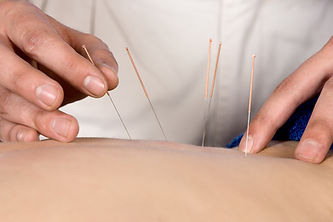
Dry needling uses a fine needle to release tight, painful muscle knots, and most people are surprised by how quick and manageable it is.
Here I explain what it involves, whether it hurts, and the kinds of problems it helps with, so you know what to expect before you try it.
SO WHAT IS DRY NEEDLING?
Dry needling is a technique used by physiotherapists to treat muscular pain and dysfunction. We use very fine acupuncture needles to target specific points within the muscle tissue.
It is called dry needling because no fluid is injected. The needle itself is the treatment.
People often ask whether dry needling is the same as acupuncture. It is a good question, and the answer is more nuanced than a simple yes or no.
There are actually two types of acupuncture. Traditional Chinese acupuncture is based on the concept of energy pathways through the body. Western medical acupuncture, which is what we practice at Choose Health, takes a different approach. It is grounded in anatomy and physiology and uses needles to stimulate specific points based on clinical evidence.
Dry needling sits alongside Western medical acupuncture in that it is also science-based and anatomy-driven. The key difference is in what we are targeting and why. Dry needling is specifically focused on trigger points within muscle tissue, aiming to produce a twitch response, release tension, and interrupt the pain cycle. Western medical acupuncture casts a slightly wider net, drawing on knowledge of nerve pathways, pain science, and the body's own regulatory systems.
The needles look identical. But the reasoning behind where they go, what we are looking for, and what we are trying to achieve is specific to each approach.
HOW DOES IT ACTUALLY WORK?
The needles are placed into what are called trigger points. These are small, irritable areas within the muscle that are often tight, tender to touch, and can refer pain to other parts of the body.
You may have noticed that pressing on a tight spot in your shoulder causes a dull ache that runs into your neck or arm. That is a trigger point. And that kind of referred pain is one of the most common reasons people end up stuck in a cycle of symptoms that never fully resolve.
When the needle enters the trigger point, it often produces what is known as a local twitch response. This is a brief, involuntary contraction of the muscle. It can feel like a momentary cramp or ache, and it tends to pass quickly.
That twitch response is actually a good sign. It means we have found the right spot, and the muscle is reacting in a way that helps it reset.
After the needle is removed, the muscle fibres relax, blood flow to the area improves, and the local inflammatory markers that were keeping the area irritated begin to clear. The nervous system also responds, which is part of why the effects can go beyond just the area where the needle was placed.
WHAT CONDITIONS DOES IT HELP WITH?
We use dry needling at Choose Health as part of a broader treatment approach, not as a standalone fix. That said, it can be particularly helpful for:

Neck and shoulder pain, including tension headaches
Lower back pain
Hip and glute tightness
Knee pain linked to tight quadriceps or ITB
Plantar fasciitis and Achilles issues
Persistent muscle tightness that has not responded to stretching or massage alone
It works especially well for people who have been dealing with something for a while, where the tissue has become habitually tight or where active trigger points are perpetuating the problem.
WHAT DOES A SESSION ACTUALLY FEEL LIKE?
This is the question most people are nervous to ask, and it is a completely understandable one.
The needles themselves are very fine. Most people are surprised at how little they feel on insertion. The sensation you are more likely to notice is the dull, achy feeling when the needle reaches the trigger point. This tends to last a few seconds and then fades.
Some muscles twitch more than others. Deep muscles in the hip or glute, for example, can produce a more noticeable response. We always talk you through what to expect before we start.
After the session, it is common to feel some muscle soreness for 24 to 48 hours, similar to how you might feel after a hard workout. This is normal and usually settles quickly.
Most people notice an improvement in their symptoms within a session or two, though how quickly you respond will depend on the nature of your problem and how long it has been going on.
WHY WE USE IT AT CHOOSE HEALTH
We do not use dry needling with everyone. It is a tool, and like any tool, it works best when it is the right fit for the job.
When we do use it, it is because we have identified that there is muscular tension or trigger point activity contributing to your symptoms that is not responding well enough to hands-on treatment or exercise alone.
We use it alongside assessment and rehabilitation, because the goal is not just to reduce your pain in the short term. The goal is to understand why that pattern of tension has developed and to give your body the input it needs to work differently going forward.
If you are based in Southampton or Winchester and you have been dealing with a persistent muscular problem, or if you have simply been wondering whether dry needling might help, we would be happy to talk it through with you at your assessment.
READY TO FIND OUT IF DRY NEEDLING IS RIGHT FOR YOU?
Getting started is straightforward. Just fill in our enquiry form by clicking here and you can have a conversation with a Physiotherapist to see if it is right for you. Following the conversation if you want to move forward we can book an initial assessment at our Southampton or Winchester clinics.
There is no commitment to treatment you are not sure about. Just an honest conversation about what we are seeing and what we think will help.


Comments